
SemanticRouter.NET

A lightweight semantic prompt router for .NET 10 and ASP.NET Core. It sends every prompt to the cheapest model that is capable enough to answer it, choosing across:
- local models (LM Studio, Ollama, vLLM),
- your own subscription CLIs (Claude Code, GitHub Copilot CLI, Codex CLI),
- paid APIs (OpenAI, Anthropic, Gemini, Azure OpenAI, OpenRouter, …).
When a subscription hits its usage limit, the router cools that model down and moves on to the next-best one automatically.
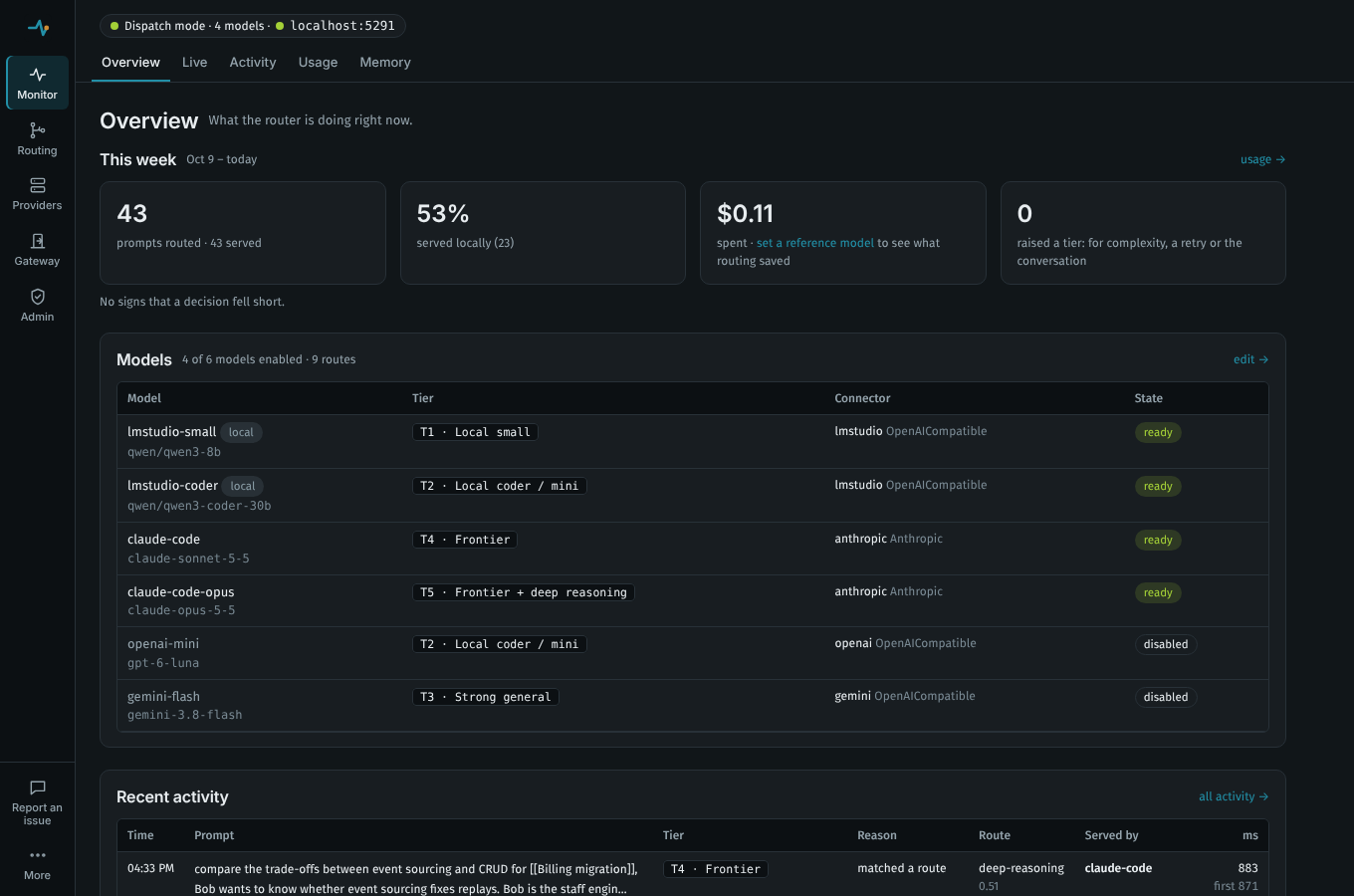
It speaks the OpenAI chat-completions, OpenAI Responses and Anthropic protocols, so you can point Claude Code, Codex CLI, the OpenAI SDKs or any chat tool at it and keep working exactly as before: the tool keeps its own model names and its agentic loop, and the router decides which backend answers each turn. A built-in dashboard shows live activity and lets you edit every setting, with hot reload, and its memory map shows which of your notes (an Obsidian vault, Claude Code's memory, an MCP memory graph) reach local models and which reach the cloud.
Quick start
For anyone who uses Claude Code, Codex or another OpenAI or Anthropic client and wants the easy prompts answered by a local model or a flat-rate subscription instead of the most expensive model. The command-line tool needs the .NET 10 SDK; the desktop app (Windows, macOS, Linux) needs nothing else and runs the router from the tray.
dotnet tool install -g SemanticRouter.Host
semantic-router init    # finds LM Studio, Ollama and the claude, codex and copilot CLIs on this machine
semantic-router         # starts the router; the dashboard is at http://localhost:5080/router
Then run Claude Code through it, with the line the router prints (your context window included):
ANTHROPIC_BASE_URL=http://localhost:5080 ANTHROPIC_AUTH_TOKEN=semantic-router CLAUDE_CODE_AUTO_MODE_SERVER=0 claude --model semantic-routerNothing found to answer with? The dashboard's Overview sets up a model. Next: Connect your tools (Codex, the SDKs, curl), Install and run (the background service, the container) and Providers.
Contents
- Quick start
- Features
- How it works
- Providers
- Install the tool
- Quick start from source
- Personal setup: LM Studio + your Claude subscription
- Using Claude Code and other tools through the router
- The dashboard
- Using it in your application
- Configuration reference
- Production guidance
- Extensibility
- Building and testing
- Roadmap
- Changes, contributing and governance
The guides are also a website with search and the demo videos: https://siebe41.github.io/SemanticRouter.NET/. The documentation index says which guide covers what: pointing Claude Code, Codex and SDKs at the router, the tool, its background service and the desktop app, the dashboard, each provider, routing quality and routing profiles, the memory map, usage and telemetry, network traffic, a machine-wide policy for administrators, verifying a release, the architecture, the roadmap, and why the subscription CLI connectors are built the way they are (Subscription CLI terms).
Features
- Three protocols in, every backend out. OpenAI chat completions, the OpenAI Responses API and the Anthropic Messages API are accepted; requests and replies are translated between them, including streaming, images and tool calls, and passed through untouched when client and backend speak the same protocol.
- Built for agentic clients. Point Claude Code or Codex at the router: their model names map through aliases, their tool-bearing turns go to tool-capable backends, the follow-up requests of a tool-calling turn stay on the model that started it, injected
<system-reminder>blocks are ignored when classifying, andcount_tokensis served locally. A CLI connector can even carry tools for them (prompted tool calling), so your Claude subscription can answer agentic turns. - See what you share. Point the router at an Obsidian vault, Claude Code's own memory (
~/.claude) or the MCP memory server's graph. The dashboard draws them as a graph and, for every request, shows which notes were in it and which model received them, local or cloud, live. Note text never leaves the router. See Memory map. - A dashboard with hot reload. Live status, cooldowns, an activity log with every decision, a prompt tester, and an editor for routes, models, connectors, tiers, routing rules, embeddings and gateway settings. Apply changes to the running router, save them to a file, or revert. Themeable (Machine Dark by default).
- Every model a provider has, each on its tier. Discover models (or
semantic-router models) lists what a connector offers and suggests a catalog entry for each: Claude's Haiku, Sonnet, Opus and Fable on four rungs, other known families (Qwen, Llama, DeepSeek, Gemma, gpt-oss, Gemini, …) from a model-family table you can extend, the rest of the local models by size, with tools, vision and context from the server's own report. It shows which local models are loaded and whether LM Studio or Ollama will load the others on demand. See Model lineups. - Named tiers. The capability ladder is explicit configuration (
Tiers), shown everywhere a tier appears, with a matrix of which routes need each rung and which models provide it. - Capability-aware, cost-aware routing. Routes declare the tier and capabilities an intent needs. Models declare their tier, capabilities, context window, cost and priority. The selector picks the cheapest model that qualifies, the most capable one, the fastest lately, or follows your priority order, and clients can choose per request (
auto:cheapest,auto:best,auto:fastest,auto:balanced,auto:priority). - Every kind of provider. There is an OpenAI-compatible HTTP connector for local servers and APIs, a CLI connector that runs Claude Code, Copilot CLI or Codex CLI on your own login, a Copilot connector on GitHub's official SDK, and an
IChatConnectorinterface for anything else. - Automatic failover and quota cooldowns. A model that is unreachable, times out, returns 5xx/429 or reports a usage limit is skipped for a cooldown period. An account-wide subscription limit cools down every model on that account at once.
- Privacy rails. Routes marked
LocalOnlycan only be served by models markedIsLocal, even on failover. Once a conversation has been kept local, its later turns, tool loops and the client's compaction and title requests about it stay local too, and naming a cloud model does not take a local-only prompt off the machine. Subscription CLI connectors refuse requests from other machines by default. - Routing profiles. Named policies for who is asking and what the code belongs to: allowed and denied models, tier floors and caps, a strategy, local-only. Picked by gateway key, header, model name (
auto@private) or rules on project and tools; a conversation containing a credential can be kept local automatically. See Routing profiles. - Zero-dependency core.
SemanticRouter.Corereferences no NuGet packages. It has SIMD cosine similarity overReadOnlySpan<float>(System.Numerics.Vector<T>), a tokenizer-free token estimator, complexity heuristics, and the route and model selectors. It is AOT-compatible. - Explainable decisions. Every decision carries a reason, a tier, route similarities, complexity signals and the ranked model list. These are exposed through
X-Prompt-Route-*headers, structured logs, metrics and a diagnostics endpoint. - Two middleware modes. Dispatch serves requests through the connectors and streams the reply back. Annotate only attaches the routing plan, so your own endpoint makes the call.
How it works
It decides in two steps:
- What does this prompt need? Embedding similarity against your intent clusters, plus cheap structural complexity heuristics, produce a required capability tier, required capabilities (
code,tools,vision, …) and an optional local-only constraint. - Which model should answer? Your model catalog is ranked by a strategy: cheapest capable, most capable or your own priority. The router then tries the models in order through their connectors, failing over when a model is down or out of quota.
prompt                                              needs                 → served by (LM Studio + Claude Code catalog)
"hello, how are you today?"                         tier 1                → lmstudio-small   (free, local)
"write a unit test for this function: …"            tier 2 + code         → lmstudio-coder   (free, local)
"compare event sourcing and CRUD trade-offs"        tier 4                → claude-code      (your subscription)
"summarize this, then analyze step by step…"        tier 1 → 3 by complexity → claude-code
"look up the customer record for account 4471"      tier 1, local only    → lmstudio-small   (never leaves the machine)
  … Claude session limit reached …                  tier 4                → lmstudio-coder   (best available; Claude cools down)
Three front doors: OpenAI-compatible (POST /v1/chat/completions, GET /v1/models) for any tool with a configurable base URL, the Anthropic Messages API (POST /v1/messages) for Claude Code and the Anthropic SDKs, and the OpenAI Responses API (POST /v1/responses) for Codex CLI and the Agents SDK. Send "model": "auto" and let the router choose, or keep the tool's own model names and map them with aliases.
The classifier, router, connectors and extractor are rebuilt as one unit when configuration changes, so edits from the dashboard apply without a restart. Architecture walks through a request step by step.
Step 1: requirements from the prompt
Semantic matching. Each route is an intent cluster: example utterances plus the Tier (and optionally RequiredCapabilities and LocalOnly) that intent needs. Utterances are embedded once, in a batch, and stored L2-normalized in one contiguous matrix. Scoring a prompt costs one embedding call and a sweep of SIMD dot products (MaxSimilarity nearest neighbour, or Centroid). Only the prompt's prose is embedded: fenced code blocks, and unfenced runs of eight or more lines that look like pasted code or logs, are left out, so a long function under "write a unit test for this function" does not hide the instruction. A prompt that is only code is embedded whole, and the complexity heuristics below still read the code. Local-only routes are still checked against the whole prompt: while any route is LocalOnly, a prompt with something left out is embedded twice (prose and whole, in one call), and a local-only match of either keeps it local, so pasted private data cannot slip past a local-only route.
Complexity heuristics. A single pass extracts four signals in [0, 1]:
| Signal | Measures |
|---|---|
| Length | sqrt(min(1, tokens / TokenSaturation)) from a BPE-like token estimate |
| Code | fenced code blocks, or runs of code-like lines |
| Structure | list items, headings, multiple questions, many lines |
| Reasoning | whole-word phrases such as step by step, trade-offs, root cause, prove |
These combine with a noisy-OR, 1 − Π(1 − weightᵢ·signalᵢ), so a single strong signal can raise the score on its own.
Policy (DefaultRouteSelector). Requirements only ever go up:
| Condition | Required tier | RoutingReason |
|---|---|---|
| Best route below its similarity threshold | FallbackTier (default 3) | NoMatchFallback |
| Route matched | the route's Tier, capabilities, LocalOnly | SemanticMatch |
Other routes within AmbiguityMargin of the best | highest of their tiers; capabilities unioned; local-only is sticky | AmbiguousMatchEscalation |
Complexity reaches a ComplexityTiers rule (default 0.45→2, 0.65→3, 0.85→4) | raised to that tier | ComplexityEscalation |
Complexity ≥ ComplexityShortCircuitThreshold (skipped while any route is local-only) | tier from complexity alone, no embedding call | ComplexityShortCircuit |
| Request names a catalog model | that model only | ModelOverride |
The message (or an earlier one in the conversation) starts with a callout such as @opus or @tier2 | what the callout asks | ExplicitCallout |
Classifier failed and FailOpen is on | FallbackTier, local-only while any route is local-only | ClassifierFailure |
The conversation needed a higher tier on recent turns, e.g. "ok, go ahead" in the middle of a task (Middleware:Conversation, on by default) | the conversation's floor, which decays as it moves on to simpler work | ConversationFloor |
The same client repeats a prompt soon after it was answered (Middleware:RetryEscalation, off by default) | one tier above the model that answered | RetryEscalation |
A request an agentic client makes for itself, recognised by its wording: a session title, a topic check, a compaction summary, a warm-up ping, a shell command check (Middleware:Housekeeping, on by default) | Housekeeping:Tier (1), no embedding call | ClientHousekeeping |
| The first turn of a session the client resumed from a compaction summary ("This session is being continued from a previous conversation…") | Housekeeping:ResumedTier (4); later turns keep it as the conversation's floor | ResumedSession |
The request itself adds requirements. If it defines tools, the model must declare tools. If it contains images, the model must declare vision. The size of the whole conversation, including tool definitions, is checked against each model's ContextWindow.
Step 2: choosing a model
A model is eligible when it is:
- enabled and not in cooldown,
- allowed by the request's routing profile, if it has one,
- inside its
ActiveHours, if it has them, - local, if the request is local-only,
- declares every required capability,
- has a context window that fits the request.
Eligible models that meet the required tier are ordered by the strategy:
| Strategy | Order | Use it when |
|---|---|---|
CheapestCapable (default) | free local models (loaded ones first, then tier ↓), then free remote models such as subscriptions (tier ↑), then paid models (cost ↑, then tier ↑); then Priority ↑ | you want the cheapest model that is good enough. A local model costs nothing, so the most capable one that is already loaded answers, and nothing waits for a model to load. A subscription costs quota, so it comes after local models and its lowest sufficient tier goes first, saving premium quota for prompts that need it. |
MostCapable | tier ↓, then cost ↑ | quality matters more than cost |
Priority | your Priority ↑, then cost ↑ | you want explicit control |
Fastest | typical time to first byte ↑, then cost ↑ | waiting matters more than cost |
Balanced | the models within BalancedLatencyFactor of the fastest by cost ↑, then the rest by cost ↑ | cheap, but not much slower than the quickest |
A model's typical time to first byte is the median over its served turns in the last LatencyWindow (a day), each timed from when that model was asked (not counting a model that failed before it), once it has LatencySamples (5) of them. A model without enough turns counts as the median of the others; with no data at all, Fastest and Balanced order by cost. They pick the model and record why: the Activity page shows it, and Dispatch sends it as X-Prompt-Route-Selection, e.g. fastest: quick (300 ms to first byte) over cheaper cloud (1,500 ms to first byte).
Estimated cost counts the prompt cache. A model that reads most of a long conversation from its prompt cache at a tenth of the input price can cost less than one with a lower list price and no cache. So the estimate splits the request's input by the share each model read from and wrote to its cache on recent served turns (CacheShareWindow, a day): that part at CacheReadCostPerMillionTokens and CacheWriteCostPerMillionTokens, the rest at the input price. The share is learned per route once a model has CacheShareSamples (5) turns with reported usage there, otherwise over all its turns; with fewer, the list prices apply, as they do for a model without cache prices. Every strategy's cost ordering uses this estimate, and so do the per-route model trials. The Models page shows the effective input price next to the list price.
With AllowBelowRequiredTier (the default), the remaining eligible models follow, most capable first. When every tier-4 model is out of quota, a hard prompt still gets the best answer available rather than an error.
Failover. In Dispatch mode the router tries up to MaxAttempts candidates. Failover is only possible before any output reaches the client; once tokens are streaming, that model owns the response. Failures put the model into cooldown:
| Failure | Cooldown |
|---|---|
| Unreachable, timeout, HTTP 401/403/404/408/5xx, CLI crash | FailureCooldown (30 s) |
| HTTP 429, a CLI usage-limit message ("You've hit your session limit", "usage limit", …) | QuotaCooldown (15 min) |
| Account-wide CLI limit (session/weekly) | every model on that connector |
GET /v1/models shows which models are cooling down and until when.
Providers
| Provider | Connector | Billing | Notes |
|---|---|---|---|
| LM Studio, Ollama, vLLM, llama.cpp server | OpenAICompatible | free (local) | mark IsLocal: true |
| OpenAI, Azure OpenAI, OpenRouter, Groq, Mistral, LiteLLM | OpenAICompatible | per token (API key) | |
| Anthropic API | OpenAICompatible (Anthropic's OpenAI-compatible endpoint) | per token (API key) | |
| Google Gemini API | OpenAICompatible (/v1beta/openai/chat/completions) | per token (API key) | |
| Claude Code CLI | Cli, preset ClaudeCode | your Claude subscription | personal, local use; see Subscription CLI terms |
| GitHub Copilot (SDK) | Copilot | your Copilot plan (AI credits) | personal, local use; native tools and streaming; GitHub Copilot SDK |
| GitHub Copilot CLI | Cli, preset GitHubCopilot | your Copilot plan (AI credits) | personal, local use |
| OpenAI Codex CLI | Cli, preset Codex | your ChatGPT plan | personal, local use |
| Anything else with a CLI | Cli, preset Custom | – | argument template with {model}, {prompt} |
| Anything else | your own IChatConnector | – |
The subscription connectors (the CLIs and Copilot) answer with whatever account the CLI is signed in to, which may be a personal plan. On a work machine, read Using it at work first.
Not included, on purpose:
- GitHub Models API: retired on 30 July 2026.
- Gemini CLI on a Google login: consumer login was shut off in June 2026, and Google's terms prohibit piggybacking on the CLI's OAuth. Use the Gemini API with a key instead.
Provider setup has setup steps for each provider.
Install the tool
The fastest way to use the router is the semantic-router .NET tool. It needs the .NET 10 SDK (installing a .NET tool is an SDK command) and nothing cloned:
dotnet tool install -g SemanticRouter.Host
semantic-router init      # finds LM Studio / Ollama models and the claude, codex and copilot CLIs; no server needed for embeddings
semantic-router doctor    # checks every connector without calling a model, and lists every host the router contacts
semantic-router models    # lists what each connector offers, with suggested tiers
semantic-router           # http://localhost:5080, dashboard at /router
semantic-router service install   # or keep it running in the background, started whenever you sign in
init writes ~/.config/semantic-router/semantic-router.json (~/Library/Application Support/semantic-router on macOS, %APPDATA%\semantic-router on Windows). When the router starts, it prints a request to try it with, where to watch it on the dashboard, and the one-line Claude Code command; while no model is enabled it points to the setup on the dashboard's Overview instead. Using Claude Code and other tools through the router explains the variables. init asks before enabling each subscription CLI it finds, because that CLI answers on whatever account it is signed in to (Using it at work); --yes enables them without asking, --enable-cli claude,codex enables just those, and --no-cli leaves them out. Everything else is done on the dashboard. service install sets the router up as a per-user background service (systemd on Linux, launchd on macOS, a sign-in entry on Windows), so no terminal has to stay open. Prefer an icon? The desktop app (an installer for Windows, macOS and Linux, with updates) runs the router from the tray and shows the dashboard in its own window or your browser. A container image covers API-key and local-model setups. See Install and run.
Quick start from source
To work on the library or try the samples, you need the .NET 10 SDK, feature band 10.0.4xx (global.json).
git clone https://github.com/siebe41/SemanticRouter.NET.git
cd SemanticRouter.NET
dotnet test
dotnet run --project samples/RoutingApiSample --launch-profile annotate
The sample starts in Annotate mode with in-memory hashing embeddings. It needs no model, CLI or key. Open the dashboard at http://localhost:5080/router, or ask it which model it would use:
curl -s http://localhost:5080/semantic-router/classify \
  -H 'Content-Type: application/json' \
-d '{"prompt":"why does this async code deadlock when I call .Result?"}'{
"requiredTier": 4, "reason": "SemanticMatch", "route": "complex-code", "similarity": 0.81,
"localOnly": false, "requiredCapabilities": ["code"],
"routes": [{ "route": "complex-code", "tier": 4, "similarity": 0.81 }, …],
"models": [{ "model": "claude-code", "connector": "claude-cli", "tier": 4, "estimatedCostUsd": 0, "meetsRequiredTier": true },
{ "model": "claude-code-opus", … }, { "model": "lmstudio-coder", …, "meetsRequiredTier": false }],
"complexity": { "score": 0.048, "estimatedTokens": 13, … }
}A prompt that starts with a callout (@opus …) is routed as the gateway routes a first turn with it: the response's callout names the tag and the prompt is classified without it.
samples/RoutingApiSample/RoutingApiSample.http has a request for every routing outcome.
Personal setup: LM Studio + your Claude subscription
Start here:
samples/LmStudioClaudePocis a ready-to-run proof of concept for exactly this setup. Rundotnet run --project samples/LmStudioClaudePoc -- --demo; it checks both backends, then shows prompts being routed live.
This is the "use local models for the easy stuff, my subscription for the hard stuff" configuration.
LM Studio. Load a small chat model, a coder model and an embedding model (e.g.
text-embedding-nomic-embed-text-v1.5), then start the server on port 1234. Check the exact model IDs withcurl http://localhost:1234/v1/modelsand put them inappsettings.json(Models[].Model,Embeddings:Model).Claude Code. Install it and sign in once by running
claudeand using/login. The router never sees your credentials: it runs theclaudebinary, which uses its own login.Run the router.
bashdotnet run --project samples/RoutingApiSample --launch-profile dispatchPoint your tools at it. Base URL
http://localhost:5080/v1, any API key, and modelauto:bashcurl -N http://localhost:5080/v1/chat/completions -H 'Content-Type: application/json' \ -d '{"model":"auto","stream":true,"messages":[{"role":"user","content":"Compare event sourcing and CRUD"}]}'Or point Claude Code at it and keep using Claude Code as before:
bashANTHROPIC_BASE_URL=http://localhost:5080 ANTHROPIC_AUTH_TOKEN=semantic-router claude --model semantic-router
Enable copilot, codex or the paid API models in appsettings.json or the dashboard as you need them. With CheapestCapable:
- free local models answer whatever they are good enough for;
- flat-rate subscriptions take the hard prompts;
- paid APIs are used only when nothing cheaper qualifies (for example, a request with images, which CLI connectors cannot handle, or with
toolswhen no local model orToolCalling: PromptedCLI connector carries them) or when everything cheaper is cooling down.
Using Claude Code and other tools through the router
The router is a drop-in base URL. Claude Code speaks the Anthropic Messages API, so:
export ANTHROPIC_BASE_URL=http://localhost:5080
export ANTHROPIC_AUTH_TOKEN=semantic-router   # any value; the router never reads or forwards it
claude --model semantic-router
--model semantic-router makes Claude Code show that the router picks the model. The router's start-up banner prints the same as one line, with CLAUDE_CODE_MAX_CONTEXT_TOKENS for your models and CLAUDE_CODE_AUTO_MODE_SERVER=0 (Connecting Claude Code). Nothing else about your workflow changes. Claude Code keeps its system prompt, its tools and its model names; the router decides per turn:
| Claude Code sends… | The router… |
|---|---|
its default claude-opus-…, /model sonnet, haiku for side tasks | maps the name through Middleware:ModelAliases: the init template routes every Claude name as auto, and *haiku* as auto:cheapest. Claude Code sends its default Opus name whether or not you chose Opus, so ask for Opus with @opus or --model opus-pinned. Unknown names route as auto, catalog names force that model |
| a turn with tools (every main-loop turn) | requires tools: HTTP models declaring it (a local coder model, an API-key model) or a CLI connector with ToolCalling: Prompted |
| tool results (the loop continuing) | pins the request to the model that issued the tool calls (ConversationAffinity) |
<system-reminder> and other injected context blocks, count_tokens calls | ignores the former when classifying; answers the latter from its own estimator |
Where agentic turns can go. A tool-bearing turn needs a backend that carries tools: an OpenAI-compatible model with function calling (LM Studio or Ollama with qwen3-coder, vLLM, OpenRouter, OpenAI), an Anthropic connector (API key, requests pass through untouched), or a CLI connector with prompted tool calling: the tools are described in the prompt, the model answers with a fenced tool_call block, the router turns it into a real tool_use, and Claude Code runs the tool as usual. The subscription stays text-in/text-out; it costs more quota than native use because every turn re-sends the context. Details, limits and snippets for Codex, the OpenAI SDKs, Aider and curl: Connect your tools.
The dashboard
app.MapRouterDashboard("/router");   // UI at /router, admin API under /router/api (loopback only unless a token is set)
builder.Services.AddSemanticPromptRouting(config).UseConfigurationFile("semantic-router.json");   // optional: persist changes
A rail of five sections, each with its pages as tabs. Monitor: Overview (models and cooldowns, connector health, the weekly digest, served-by and required-tier charts, a prompt tester), Live (a streaming view of clients, the router and models, with every decision as it happens), Activity (every routed request with its decision and outcome), Usage, and Memory (your notes as a graph, coloured by which models they reached; see Memory map). Routing: editors for Tiers, Routes, Rules and Profiles, Evaluate, and Router learned (what automatic tuning changed, each change undoable). Providers: Models, Connectors and Embeddings. Gateway: its settings and Connect clients. Admin: the JSON editor and the Audit log. Report an issue (a pre-filled GitHub issue for a misroute, a bug or an idea) sits at the foot of the rail (every page). Validate → Apply & save swaps a new runtime in atomically and writes the configuration file (Apply only leaves the file as it is, and the top bar says the running configuration is not saved), which replaces the SemanticRouter section on the next start (secrets left empty are inherited from it). The admin API behind it takes the same JSON document, so a tested configuration can be promoted with one PUT. Themes are CSS token blocks; drop a token file into themes/ next to the configuration and it appears in the picker after a reload. It works with a keyboard and a screen reader, and on a phone. See Dashboard.
Using it in your application
Dispatch mode: the router is your gateway
var builder = WebApplication.CreateBuilder(args);
builder.Services.AddSemanticPromptRouting(builder.Configuration.GetSection("SemanticRouter"));

var app = builder.Build();
app.UsePromptRouter();          // serves POST /v1/chat/completions, /v1/messages and /v1/responses (Middleware:PathPrefixes / AnthropicPathPrefixes / ResponsesPathPrefixes)
app.MapRouterModels();          // GET /v1/models
app.MapAnthropicTokenCount();   // POST /v1/messages/count_tokens
app.MapRouterDashboard();       // the dashboard and admin API at /router
app.Run();
HTTP connectors forward the original body untouched apart from model when the client speaks their protocol, so tool calls, images and SSE pass straight through; otherwise they translate the request and the reply (JSON or SSE) between the OpenAI and Anthropic formats. The client's own Authorization/x-api-key headers are never forwarded; credentials come from configuration.
CLI connectors turn the conversation into a prompt, run the CLI with its tools disabled, and return a reply in the client's protocol (chat.completion or an Anthropic message, streamed when asked). With ToolCalling: Prompted they also carry the client's tools.
Annotate mode: your endpoint makes the call
app.UsePromptRouter();

app.MapPost("/chat", async (ChatRequest request, HttpContext context, MyClients clients) =>
{
    RoutingPlan plan = context.GetPromptRouting()!;
    ModelDefinition model = plan.Candidates[0].Model;     // best model; the rest are fallbacks
    return await clients.For(model.Connector).CompleteAsync(model.Model, request);
});
Code-first configuration
builder.Services
    .AddSemanticPromptRouting(o =>
    {
        o.DefaultSimilarityThreshold = 0.65f;
        o.Routes.Add(new RouteDefinition { Name = "smalltalk", Tier = 1, Utterances = { "hi", "thanks!", "how are you?" } });
        o.Routes.Add(new RouteDefinition { Name = "design", Tier = 4, Utterances = { "design a scalable architecture" } });
    })
    .AddConnector("lmstudio", c => c.BaseAddress = new Uri("http://localhost:1234"))
    .AddConnector("claude-cli", c => { c.Type = ConnectorType.Cli; c.Preset = CliPreset.ClaudeCode; })
    .AddModel(new ModelDefinition { Name = "local", Connector = "lmstudio", Model = "qwen/qwen3-8b", Tier = 1, IsLocal = true })
    .AddModel(new ModelDefinition { Name = "claude", Connector = "claude-cli", Model = "sonnet", Tier = 4 })
    .UseOpenAICompatibleEmbeddings(e =>
    {
        e.Endpoint = new Uri("http://localhost:1234");
        e.Model = "text-embedding-nomic-embed-text-v1.5";
    })
    .ConfigureMiddleware(m => { m.Mode = PromptRouterMode.Dispatch; m.PathPrefixes.Add("/v1/chat/completions"); });
Core only (console apps, workers, agent frameworks)
var options = new SemanticRouterOptions { DefaultSimilarityThreshold = 0.3f };
options.Routes.Add(new RouteDefinition { Name = "summarize", Tier = 1, Utterances = { "summarize this article" } });
options.Models.Add(new ModelDefinition { Name = "local", Connector = "lmstudio", Tier = 1, IsLocal = true });
options.Models.Add(new ModelDefinition { Name = "frontier", Connector = "api", Tier = 4, InputCostPerMillionTokens = 3, OutputCostPerMillionTokens = 15 });

var router = new PromptRouter(new SemanticPromptClassifier(new HashingEmbeddingProvider(), options), options);
RoutingPlan plan = await router.RouteAsync(new PromptRoutingRequest { Prompt = "please summarize this article about Rust" });
// plan.Classification.RequiredTier == 1, plan.Candidates[0].Model.Name == "local"
Configuration reference
Everything binds from the SemanticRouter section. samples/RoutingApiSample/appsettings.json is a complete annotated example.
SemanticRouter
| Key | Default | Description |
|---|---|---|
Routes[] | [] | Intent clusters (below). |
Models[] | [] | The model catalog (below). |
Connectors:{name} | {} | How to reach providers (below). |
Tiers[] | 5 built-in levels | { Level, Name, Description }: names for the tier numbers, shown by the dashboard and /v1/models. Routing compares the numbers. |
DefaultSimilarityThreshold | 0.75 | Minimum cosine similarity for routes without their own threshold. |
FallbackTier | 3 | Tier required when nothing matches or classification fails. |
ComplexityTiers[] | 0.45→2, 0.65→3, 0.85→4 | { MinScore, Tier } rules that raise the tier. An empty list disables them. |
ComplexityShortCircuitThreshold | 0.9 | Skip embedding for obviously hard prompts. Set above 1 to disable. |
AmbiguityMargin | 0.02 | Near-tied routes contribute their tier. 0 disables. |
ScoringStrategy | MaxSimilarity | MaxSimilarity or Centroid. |
EmbedProseOnly | true | Embed a prompt without its fenced code blocks and long pasted code or logs (eight or more lines that look like code). Local-only routes are still checked against the whole prompt. false embeds the whole prompt. |
ClassificationCache:Enabled / MaxEntries / MaxAge | true / 2048 / 00:10:00 | Reuse a recent decision for the same prompt (whitespace-normalised) instead of embedding it again. In memory, per configuration version. |
Profiles:{name} | {} | Routing profiles: AllowedModels[], DeniedModels[] (globs), AllowedConnectors[], DeniedConnectors[], MinTier, MaxTier, Strategy, LocalOnly, Description. See Routing profiles. |
Complexity:* | TokenSaturation, {Length,Code,Structure,Reasoning}Weight, ReasoningKeywords, … | |
Selection:Strategy | CheapestCapable | CheapestCapable, MostCapable, Priority, Fastest or Balanced. |
Selection:BalancedLatencyFactor | 1.5 | For Balanced: how many times slower than the fastest model a cheaper model may be. |
Selection:LatencyWindow / LatencySamples | 1.00:00:00 / 5 | The recent served turns a model's typical time to first byte is taken from, and how many it needs. |
Selection:CacheShareWindow / CacheShareSamples | 1.00:00:00 / 5 | The recent served turns the share of input a model reads from and writes to its prompt cache is taken from, and how many it needs (per route, or over all its turns), for cost estimates. |
Selection:AllowBelowRequiredTier | true | Degrade to the best available model instead of failing. |
Selection:MaxAttempts | 3 | Models tried per request. |
Selection:QuotaCooldown / FailureCooldown | 00:15:00 / 00:00:30 | How long failed models are skipped. |
Selection:EstimatedOutputTokens | 512 | Used for cost estimates and context-window checks. |
Selection:TimeZone | this machine's | IANA zone that models' ActiveHours follow. |
Routes[]
| Key | Default | Description |
|---|---|---|
Name | – | Unique. |
Tier | 1 | Minimum model tier. Suggested scale: 1 small local · 2 mid/mini · 3 strong · 4 frontier · 5 frontier + deep reasoning. |
RequiredCapabilities[] | [] | Tags the model must declare (e.g. code). |
Utterances[] | – | 5–20 diverse examples. |
SimilarityThreshold | null | Per-route override. |
LocalOnly | false | Only IsLocal models may answer, even on failover. |
PreferredModel | none | A catalog model that serves the route's plain matches first, even below Tier. Automatic tuning sets it when a trial of a cheaper model goes well (Cheaper models per route); escalated, explicit and conversation-held turns are routed by the tier. |
FollowsConversation | false | Prompts that say nothing about difficulty ("go ahead", "continue"): in a conversation they take its tier, down as well as up; Tier applies only on a first turn. The init template's continuation route has it. |
Models[]
| Key | Default | Description |
|---|---|---|
Name | – | Unique catalog name. Clients may request it directly as model. |
Connector | – | Name of a configured connector. |
Model | null | Provider model ID sent to the connector (e.g. qwen/qwen3-8b, sonnet, gpt-6.1-sol). |
Tier | 1 | Capability tier. |
Capabilities[] | [] | e.g. chat, code, tools, vision, reasoning. CLI-backed models declare tools only when their connector has ToolCalling: Prompted, and never vision. |
IsLocal | false | Data stays on your machine. |
ContextWindow | 0 (unknown) | Tokens. Models too small for a request are skipped. |
InputCostPerMillionTokens / OutputCostPerMillionTokens | 0 | Marginal USD cost. Use 0 for local models and flat-rate subscriptions. |
CacheReadCostPerMillionTokens / CacheWriteCostPerMillionTokens | input price | Prompt-cache prices, for the usage and cost figures and for cost estimates once the model's cache share is known. |
Priority | 0 | Lower is preferred. Breaks ties; primary key for the Priority strategy. |
Enabled | true | |
ActiveHours | null (always) | HH:mm-HH:mm, may cross midnight. Outside the window the model is not tried. |
Connectors:{name}
| Key | Applies to | Default | Description |
|---|---|---|---|
Type | all | OpenAICompatible | OpenAICompatible, Anthropic (Messages API), Responses (OpenAI Responses API), Cli, or Copilot (GitHub's Copilot SDK; package SemanticRouter.Connectors.Copilot, included in the tool). |
BaseAddress, RequestPath | HTTP | –, /v1/chat/completions (/v1/messages for Anthropic, /v1/responses for Responses) | |
ApiKey, Headers | HTTP | Bearer token (x-api-key for Anthropic) and extra headers. Keep keys in user-secrets or environment variables, or write a reference: "${env:OPENAI_API_KEY}", "${secret:…}". | |
ForwardHeaders[] | HTTP | [] | Client request headers to relay upstream (e.g. anthropic-beta). Authorization headers never are. |
AnthropicVersion | Anthropic | 2023-06-01 | Sent as anthropic-version. |
PromptCaching | Anthropic | Auto | Auto: requests translated from OpenAI and Responses clients get cache markers (end of the system prompt, plus automatic caching for the conversation) when the prompt is above the model's cacheable minimum. Off: none. See Prompt caching on translated requests. |
CacheTtl | Anthropic | 5m | 5m or 1h: how long those cache entries live, and so how long conversation routing counts them warm. A one-hour entry costs 2× the input price to write instead of 1.25×. |
ToolCalling | CLI | None | None: decline tool-bearing requests. Prompted: describe the tools in the prompt and parse tool_call blocks from the reply. |
StreamPromptedReplies | CLI | true | With Prompted: stream the reply's text and hold back only what may be a tool call. false buffers the reply, so a failed run can still fail over. |
RepairToolCalls | CLI | true | With Prompted: re-ask once, briefly, for a tool call that could not be read. See Prompted tool calling in practice. |
PromptedToolParsing | CLI | Lenient | With Prompted: Strict reads only the run's own randomly labelled fence, at the end of the reply, naming one of the request's tools, as a call; Lenient also takes near misses (bare JSON, other labels, calls followed by text). In both, tool results are defused and a call copied from one stays text. Lenient stays the default until Strict has been measured on smaller models. See Forged tool calls. |
Preset | CLI | Custom | ClaudeCode, GitHubCopilot, Codex or Custom. |
Executable | CLI | preset's command | Started directly, never through a shell, by its full path: a bare name is looked up on the absolute PATH entries only, never in the current directory. On Windows use the .exe. |
Arguments[] | CLI | Custom: the full template ({model}, {prompt}). Presets: extra arguments appended. | |
PromptInput | CLI | Stdin | Stdin or Argument. Argument puts the prompt on the command line (Custom: the {prompt} placeholder), where other users of the machine can read it while the CLI runs. Codex always uses stdin. |
QuotaErrorPatterns[] | CLI | preset patterns | Extra output fragments that mean "quota exhausted". |
EnvironmentVariables, RemoveEnvironmentVariables[] | CLI | preset defaults | The presets remove API-key variables that would switch billing away from your subscription. |
MaxConcurrency | CLI, Copilot | 2 | Simultaneous processes (Copilot: simultaneous turns). |
MaxQueue | CLI, Copilot | 16 | When this many requests are already waiting for a process, the next goes to another model. 0: never wait. |
MaxArgumentLength | CLI | 24000 | With PromptInput: Argument, longer prompts are sent on stdin. Longer Claude Code system prompts are moved into the conversation. |
Executable, HomeDirectory | Copilot | copilot, ~/.copilot | The Copilot CLI the SDK runs as its runtime, and its COPILOT_HOME. |
AllowRemoteClients | CLI, Copilot | false | See Subscription CLI terms before changing this. |
Timeout | all | HTTP 100 s · CLI 5 min | Time to first output. |
StallTimeout | HTTP, CLI | the Timeout | Time allowed between two pieces of a reply once it has started. A backend that stops sending for longer is given up on: before anything reached the client the next model answers; after, the client gets an error event and the model cools down. A reply that keeps coming is never cut off. |
Embeddings, Middleware and the other sections
| Key | Default | Description |
|---|---|---|
Embeddings:Provider | Hashing | Hashing (dev only), Onnx (in-process model, see below) or OpenAICompatible (Endpoint, Model, ApiKey, RequestPath, MaxBatchSize, Timeout). |
Embeddings:IsLocal | loopback Endpoint only | Whether an OpenAICompatible endpoint keeps prompts on this machine (or a server you control). When it does not, requests already known to be local-only (a local-only profile, LocalOnlyWhen, @local, a conversation kept local) are classified by complexity alone instead of being sent to it, tuning and evaluation leave local-only prompts out, and a warning says that local-only routes still need every prompt embedded there first. |
Embeddings:Model / ModelPath / Pooling | For Onnx: all-MiniLM-L6-v2 (default) or bge-small-en-v1.5, downloaded on first use; or ModelPath, a directory with your own model.onnx and vocab.txt, with Pooling Mean or Cls. Needs the SemanticRouter.Embeddings.Onnx package (.AddOnnxEmbeddings() / .UseOnnxEmbeddings()); the tool includes it. | |
Embeddings:WarmUpOnStartup | true | Embed utterances in the background at startup. |
Middleware:Mode | Annotate | Annotate or Dispatch. |
Middleware:PathPrefixes[] | [] (all JSON POSTs) | Paths carrying OpenAI chat-completions bodies. Required in Dispatch mode. |
Middleware:AnthropicPathPrefixes[] | /v1/messages | Paths carrying Anthropic Messages bodies (Claude Code). Errors on them use the Anthropic format. |
Middleware:ResponsesPathPrefixes[] | /v1/responses | Paths carrying OpenAI Responses bodies (Codex CLI). Only the path itself is routed; /v1/responses/{id} is not. |
Middleware:ModelAliases | {} | Glob → alias/model map for client model names: "*haiku*": "auto:cheapest", "claude-*": "auto", "opus-pinned": "family:opus" (the catalog's Opus model, else the most capable). A key without * matches exactly and is tried before the globs. Catalog names, auto:* and the router's own names (semantic-router, claude-semantic-router…) are never remapped; unmatched names route as auto. |
Middleware:Feedback:Enabled | true | Record signs that a decision was not good enough (retried, corrected, overridden with a callout, failing tool calls, empty reply, graded low by the judge) with the decision. See Feedback. |
Middleware:Feedback:CorrectionSimilarity / CorrectionMargin | 0.72 / 0.12 | Recognise corrections no phrase covers (other wording, other languages) by comparing short follow-ups with example corrections using the routing embedding model. 0 turns it off. See Corrections in other words. |
Tuning:Mode | Apply | Automatic tuning of thresholds, utterances and cheaper models per route: Apply (shown under Router learned, each change undoable), Suggest or Off. See Automatic tuning. |
Tuning:Interval / NewLabels / MaxStep / MinimumPrompts | 1.00:00:00 / 10 / 0.02 / 20 | How often it runs, how many new labels make it run early, the most a threshold moves per run, and the labelled prompts it needs first. |
Tuning:FeedbackWeight / FeedbackDays | 0.5 / 30 | How much a prompt labelled by feedback counts next to one you labelled, and how far back feedback is used. |
Tuning:JudgeWeight / JudgeAgreementPairs | 0.75 / 10 | How much a prompt labelled only by the judge's low grade counts; once this many graded answers also have a hand label, the weight is scaled by how often the judge agrees with them. See The judge. |
Tuning:Utterances / MaxUtterancesPerRoute / LocalOnlyUtterances | true / 2 / false | Add labelled prompts a route misses as its utterances, how many per route per run, and whether local-only prompts may be added. |
Tuning:HoldDays / StrongerEvidence | 30 / 2 | How long an undone change is left alone, and how much stronger the evidence must be to suggest it again sooner. |
Tuning:ModelTrialRate / ModelTrialTurns / ModelTrialMargin | 0.05 / 20 / 0.05 | Try the next cheaper model able to do a route's work on this share of its plain matches, for this many turns; it takes the route over (PreferredModel) when its turns draw at most this much more feedback than the current model's. 0 turns trials off. See Cheaper models per route. |
Notifications:Enabled | true | The one switch for notifications (a desktop notification, a log line, the webhooks) when something needs a decision. The Overview lists the notices either way. See Digest and notifications. |
Notifications:Webhooks / DashboardUrl | Webhooks (JSON, Slack-compatible or ntfy) that get each notice when it appears and clears, and the weekly digest; the URLs are secrets. DashboardUrl makes the links in them work. See Digest and notifications. | |
Notifications:IncludeDetails | false | Let webhook messages quote text that can come from prompts or replies: utterances tuning learned from prompts and the latest error a connector returned. Off, they carry only counts, names, kinds and links. |
Notifications:ConnectorDownAfter / LimitDays | 01:00:00 / 3 | How long every request to a connector must fail before it counts as down, and on how many of the last 7 days a subscription must hit its usage limit before that needs a decision. |
Middleware:Reliability:Enabled | true | Leave a model out of the work it keeps failing at (a route, or requests with tools) for a while. See Model reliability. |
Middleware:Reliability:Window / MinimumTurns / MaxFailureRate / PeerMargin / Period | 7.00:00:00 / 10 / 0.3 / 0.15 / 1.00:00:00 | How far back turns count, the turns needed before judging, the share with feedback that counts as unreliable, how much worse than the other models it must be, and how long it is left out. |
Middleware:Judge:Enabled / Model | false / | Grade a sample of cheap answers with a catalog model (preferably local); a low grade is feedback the router learns from. See The judge. |
Middleware:Judge:SampleRate / MaxTier / DailyLimit / FailingGrade / MaxCharacters | 0.02 / 2 / 100 / 2 / 6000 | The share of eligible answers graded, the highest tier whose answers are graded, the most grades a day, the grade (1–5) at or below which it is feedback, and how much of the request and answer the judge reads. |
Middleware:Housekeeping:Enabled / Tier / ResumedTier / Patterns | true / 1 / 4 / [] | Recognise agentic clients' own requests (titles, topic checks, compaction, warm-ups, command checks) and route them to Tier without classifying; route a session resumed from a compaction summary to ResumedTier. Patterns adds regular expressions for other clients' wording; a client-turns.json next to the configuration replaces or turns off the built-in ones. See Connecting Claude Code. |
Middleware:Callouts:Enabled / Names | true / {} | Inline callouts: a message starting with @opus, @local, @best, @tier3, a catalog model name or one of your Names routes as asked for the rest of the conversation, until @auto. See Telling the router what you want. |
Middleware:PinToolCallingTurns | true | Requests carrying tool results go to the model that issued the tool calls. |
Middleware:Conversation:Enabled | true | Route by the conversation: keep the tier recent turns needed and stay on the model that answered. See Conversations. |
Middleware:Conversation:DecayTurns / IdleTimeout / ShortFollowUpLength / StickToModel | 3 / 00:30:00 / 60 / true | Simpler turns before the floor drops a tier; how long an idle conversation is remembered; the length (characters) below which a message is a follow-up that keeps the full floor; whether to prefer the previous model, or the one with the conversation's warm prompt cache when moving would cost more. |
Middleware:Conversation:CacheLifetime | 00:05:00 | How long a model's prompt cache counts as warm after a turn that used it, for backends whose cache lifetime the router cannot tell. On an Anthropic connector it follows the cache markers instead (CacheTtl, or the client's own ttl). See Conversations. |
Middleware:Conversation:SessionHeader | x-claude-code-session-id | A header with the client's session id. When a request has it, the session and the first user message identify the conversation, whatever the system prompt does. Empty turns it off. See Conversations. |
Middleware:RetryEscalation:Enabled / Window | false / 00:02:00 | A prompt repeated by the same client within the window goes one tier up. See Retry escalation. |
Middleware:StripSystemReminders | true | Ignore the context blocks clients inject into user messages when classifying: <system-reminder>, <system_reminder>, <current_datetime>, <copilot_tauri_workspace> and Middleware:InjectedTags. |
Middleware:InjectedTags | [] | More tag names (e.g. environment_details) whose blocks are ignored when classifying. |
Middleware:MaxRequestBodyBytes | 8388608 | Larger bodies get 413. Agentic clients send 100 KB+ requests. |
Middleware:EmitResponseHeaders / HeaderPrefix | true / X-Prompt-Route | X-Prompt-Route, -Tier, -Reason, -Similarity, -Complexity, -Model, -Connector, -Attempt, -Degraded, -Budget, -Dropped, -Profile, -Local-Only, -Unreliable. |
Middleware:FailOpen | true | Route with FallbackTier if classification fails. |
Middleware:MessageSelection | LastUserMessage | Which messages are classified. |
Usage:ReferenceModel, Usage:TimeZone, Usage:WarnAtPercent | –, local, 80 | Yardstick for "saved by routing", the zone budget periods follow, and when to warn. |
Usage:Budgets[] | [] | { Name, Model or Connector or Profile, Period (Day/Week/Month), MaxTokens, MaxCostUsd }. A spent budget's models are not tried until the period ends; a spent profile budget stops that profile's paid models only. |
Middleware:GatewayKeys | {} | Client keys by name ("laptop": "${env:ROUTER_KEY_LAPTOP}"). Remote clients must send one as Authorization: Bearer or x-api-key, and are refused while none is set; the name is recorded in Activity. Never forwarded. |
Middleware:AllowUnauthenticatedRemoteClients | false | Serve remote clients without a key while GatewayKeys is empty. Only behind a proxy that authenticates callers. |
Middleware:RemoteRequestsPerMinute | 120 | Requests per minute for each client on another machine that no RateLimits entry covers. 0 turns it off. |
ForwardedHeaders:KnownProxies, KnownNetworks | none | Reverse proxies whose X-Forwarded-For and X-Forwarded-Proto are believed (host setting, read at start-up). See Serving over HTTPS. |
Network:Offline / AllowedHosts | false / [] | Offline mode: the router reaches only this machine and these hosts; CLI and Copilot connectors are off and the ONNX model is never downloaded (host setting). See Offline mode. |
Network:CaBundle | none | A PEM file of CA certificates trusted for the router's own HTTPS connections (connectors, embeddings, webhooks, the ONNX download) in addition to the system store, for a proxy that inspects TLS (host setting, read at start-up). See Proxies and certificates. |
DataProtection:Certificate | none | An RSA certificate (a PFX, a PEM with its key or CertificateKey, or a CurrentUser\My thumbprint) that encrypts the data-protection keys behind the secrets file, on any platform; CertificatePassword for its password (host setting, read at start-up). Without it they are encrypted with DPAPI on Windows and protected by file permissions only on macOS, Linux and in the container. See The key ring. |
State:StorePrompts | Redacted | How much of each prompt the activity log keeps: Redacted (160 characters, credentials masked), On, or Off. The same goes for a failed CLI run's output (in the activity log and the logs) and the judge's reason. See What the router stores. |
State:Retention | store defaults | ActivityDays (30), ActivityEntries (10,000), UsageDays (400), ConfigurationVersions (200), AuditDays (365, the audit log). |
Middleware:RequireGatewayKeyForLocalClients | false | Require the key from loopback clients too (a local reverse proxy). |
Middleware:RateLimits | {} | Per gateway client (and * for the rest): { RequestsPerMinute, TokensPerMinute } over a sliding minute. A client over its limit gets 429 with Retry-After in its protocol, recorded in Activity. See Rate limits. |
Middleware:ProfileHeader / ProjectHeader | X-Router-Profile / X-Router-Project | Headers that name the routing profile and the project. Without the project header, the project is a hash of the client's user id (user: and 12 hex digits), never the id itself; a user id that is a JSON object (Claude Code's) gives no project. |
Middleware:ClientProfiles | {} | Gateway client → profile it always runs under. |
Middleware:ProfileRules[] | [] | { Profile, Clients[], Projects[], ToolsInclude[], ToolsExclude[] }; the first match picks the profile. |
Middleware:VirtualModels | {} | Model names clients can pick: { "private": { "Profile": "private", "Strategy": null, "Description": "…" } }. |
Middleware:LocalOnlyWhen:Secrets / FilePaths | false / false | Keep a conversation local when it contains a credential or an absolute file path. |
Dashboard:AdminToken, Dashboard:ReadOnlyToken | Tokens for remote dashboard access (16+ characters). See Access and security. | |
Dashboard:MetricsToken | Token for figures only: status, usage and the digest's counts, never prompt text, the configuration or activity. See Dashboard roles. | |
Dashboard:SessionLifetime | 12:00:00 | How long a dashboard sign-in lasts before the token must be entered again; signing out ends the session on the server. Five wrong tokens from one address in 15 minutes make it wait (429) until the first is 15 minutes old. |
Dashboard:AllowProcessSettings | false | Let the admin API change what a CLI connector runs and which paths memory sources read; otherwise those change only in the configuration file. See Access and security. |
Dashboard:RequireLocalClient | true | Loopback only. Turn off together with a token to reach the dashboard from other machines. |
Dashboard:PublicOrigins[] | [] | Addresses the dashboard is reached at besides localhost (https://router.home.lan): changes are accepted from these origins. |
Dashboard:RequireTokenForLocalClients / AllowUnauthenticatedRemoteClients | false / false | Require a token from loopback clients too (a reverse proxy on this machine); serve remote clients without a token (only behind a proxy that authenticates them). See Access and security. |
Dashboard:TrustedIdentityHeader / TrustedGroupsHeader | none | Header in which an authenticating reverse proxy names the signed-in user (X-Forwarded-User, X-Auth-Request-Email) and, optionally, their groups. Believed only from ForwardedHeaders:KnownProxies/KnownNetworks. See Signed-in users from a reverse proxy. |
Dashboard:TrustedIdentityRoles | {} | Role per user or group the proxy names, * for everyone else: { "alice@corp.example": "Admin", "finance": "Metrics", "*": "ReadOnly" }. A user with no role gets 403. |
Dashboard:ThemesDirectory | themes/ next to the configuration file | Drop-in theme files. See Adding a theme without rebuilding. |
Memory:Sources[] | none | { Name, Type, Path }: an Obsidian vault or notes folder (Markdown), Claude Code's memory (ClaudeCode, default ~/.claude) or the MCP memory server's graph (KnowledgeGraph). See Memory map for the rest of the Memory keys. |
Thresholds by embedding model
Similarity scales differ between embedding models. These are starting points. Calibrate on your own prompts with the dashboard's Evaluate page, which sweeps the threshold over a labelled set and recommends a value (Routing quality).
| Embedding model | Starting DefaultSimilarityThreshold |
|---|---|
HashingEmbeddingProvider (lexical, dev only) | 0.25–0.35 (the template and samples: 0.30) |
ONNX all-MiniLM-L6-v2 (in-process) | 0.40, what init sets (best on the sample set: 0.29) |
ONNX bge-small-en-v1.5 (in-process) | 0.60, what init sets (best on the sample set: 0.60–0.63) |
nomic-embed-text | 0.60–0.70 |
mxbai-embed-large | 0.65–0.75 |
OpenAI text-embedding-3-* | 0.40–0.55 |
Classification latency
Classifying a prompt is one embedding plus a dot product per utterance. Measured on the starting routes (119 utterances) and the 116-prompt sample set that init writes, with the classification cache off so every prompt is embedded. The machine had 4 logical CPUs and ran Linux. Reproduce with dotnet run -c Release --project benchmarks/SemanticRouter.Benchmarks; add -- --remote http://localhost:11434 nomic-embed-text to measure an embedding server.
| Embeddings | Index warm-up | Classify p50 | Classify p95 | Right on the sample set |
|---|---|---|---|---|
| Hashing (lexical) | 9 ms | 0.08 ms | 0.11 ms | 100/116 at 0.30 |
ONNX all-MiniLM-L6-v2 | 226 ms | 1.9 ms | 2.5 ms | 111/116 at 0.40 |
ONNX bge-small-en-v1.5 | 389 ms | 3.2 ms | 3.9 ms | 112/116 at 0.60 |
An embedding server adds a network round trip and its own inference time to every prompt. A prompt the cache has seen recently costs no embedding at all.
Gateway overhead
What the router itself adds, with no model behind it: the semantic-router tool with its SQLite state, in front of a stub backend that answers at once, with Hashing embeddings and a different short prompt on every request (not streamed). Measured on a 4 vCPU Linux container where the load generator, the stub and the router share the cores, so compare the rows with each other, not with production throughput. Reproduce with dotnet build -c Release, then dotnet run -c Release --no-build --project benchmarks/SemanticRouter.Benchmarks -- gateway; --memory-state measures the same with the state in memory, --soak 300 watches for drift and --faults checks failover, cooldowns, stalls, dropped connections, cancelled requests and two routers on one database. CI runs the short version on every pull request and the soak and faults nightly.
| Clients | Requests/s | Total time p50 / p95 / p99 | State in memory: requests/s, p99 |
|---|---|---|---|
| 1 | 1,037 | 0.8 / 1.7 / 2.9 ms | 1,224, 2.3 ms |
| 8 | 6,124 | 1.1 / 2.3 / 5.7 ms | 8,256, 4.5 ms |
| 32 | 7,847 | 3.5 / 7.5 / 12.7 ms | 10,583, 11.4 ms |
Production guidance
- Use a real embedding model. The hashing provider only captures shared words.
Onnxruns one inside the router with no server; an OpenAI-compatible server (LM Studio, Ollama) works too. - Secrets. Keep API keys in user-secrets, environment variables (
SemanticRouter__Connectors__openai__ApiKey) or a vault, never inappsettings.json. Any key, header or gateway key can be a reference instead of a value:"${env:OPENAI_API_KEY}". With.UseSecretFile(), keys typed into the dashboard are encrypted into a separate file and the configuration keeps a${secret:…}reference; the keys that decrypt it are encrypted with DPAPI on Windows, or to a certificate anywhere withDataProtection:Certificate(The key ring). Keys are redacted from error details, relayed upstream errors, activity entries and logs. - Bind to localhost when the router fronts your personal subscriptions (the sample does). CLI connectors refuse non-loopback clients anyway, unless
AllowRemoteClientsis set. Behind a reverse proxy, every request appears to come from the proxy, so keep the proxy local too. - Pipeline placement. Call
UsePromptRouter()after authentication and rate limiting. - Diagnostics. Protect
MapPromptClassification()or map it only in development. SetEmitResponseHeaders: falseto hide routing from clients. - The dashboard and its admin API change where prompts go and can show connector settings (keys are masked). By default they answer loopback clients only, and only when the
Hostheader names this machine (so a web page cannot reach them through DNS rebinding); changes must come from the dashboard's own origin. To use them from another machine, setDashboard:AdminToken(and optionallyReadOnlyTokenorMetricsToken) and turnRequireLocalClientoff; see Access and security. Keep the saved configuration file out of source control. - Resilience. HTTP connectors use the named clients
SemanticRouter.Connector.{name}, and embeddings useSemanticRouter.Embeddings. You can addMicrosoft.Extensions.Http.Resiliencehandlers to them. - Telemetry. The
SemanticRouteractivity source traces each request (route, classify, select, one span per attempt,traceparentto HTTP backends). TheSemanticRoutermeter publishes decisions, latency, time to first byte, tokens, cost, cooldowns, failovers, budget skips and CLI queue depth. Every decision is also logged with its tier, route, similarity, complexity and first-choice model, under aRouteRequestIdscope that matches theX-Prompt-Route-Idresponse header. No prompt text appears in spans or metrics. See Usage, budgets and observability. - Usage and budgets. Tokens and cost per request, the dashboard's Usage page, "saved by routing" against a reference model, and per-model or per-connector budgets that stop a model before a limit is hit. See Budgets.
Known limitations
- State is per process unless you persist it. Cooldowns, tool-call affinity, warm prompt caches, activity, usage and configuration history live in memory unless
UseSqliteStateis used (thesemantic-routertool does). The memory map's sharing counts always start at zero on a restart. Configuration applied through the dashboard is persisted only when a configuration file is registered. - CLI connectors are text in, text out. Without
ToolCalling: Prompted, requests withtoolsskip them. With it, tool calls depend on the model following the format, every turn re-sends the whole context, and images are never supported. Multi-turn chats are flattened into a labelled transcript. Each request starts a new process, which adds start-up latency compared with an HTTP call. - Cross-protocol translation keeps what has an equivalent. Tools, tool results, images, system prompts, sampling parameters, stop sequences, reasoning requests and replies, structured output and serial tool calls are translated. Documents,
logprobs, hosted tools and server-side conversation state only survive on pass-through to a backend that speaks the client's protocol. Prompt caches keep working: an Anthropic client'scache_controlmarkers reach Anthropic backends, requests translated for an Anthropic backend get markers of their own (PromptCaching), and OpenAI'sprompt_cache_keycrosses between chat completions and Responses. Whatever is left out is named inX-Prompt-Route-Dropped; see the compatibility table. - Token counts are estimates. Leave headroom in
ContextWindow. - The CLI presets track the vendors' documented flags as of October 2026. If a CLI changes, add flags through
Argumentsor use theCustompreset.
Extensibility
| To… | Do this |
|---|---|
| Add a provider with its own protocol | Implement IChatConnector and call .AddConnector<T>(). To make a new connector type selectable in configuration, register an IChatConnectorFactory; implement IModelDiscovery for the dashboard's Discover button. |
| Keep configuration somewhere other than a file | Implement IRouterConfigurationStore and call .UseConfigurationStore<T>(). |
| Use another embedding backend | Implement IEmbeddingProvider and call .UseEmbeddingProvider<T>(). For an in-process model: .UseOnnxEmbeddings() from SemanticRouter.Embeddings.Onnx. To make a new kind selectable in configuration, register an IEmbeddingProviderFactory. |
| Change how requirements are derived | Implement IRouteSelector or IComplexityAnalyzer. |
| Change how models are ranked (budgets, time of day) | Implement IModelSelector. |
| Persist cooldowns, affinity, activity and history | .UseSqliteState("semantic-router.db") from SemanticRouter.Storage.Sqlite, or implement ICooldownStore, IToolCallAffinity, IWarmCacheStore, IRoutingActivityStore, IRouterConfigurationHistory. See Durable state. |
| Support a custom payload shape | Implement IPromptExtractor. |
Registrations use TryAdd, so anything you register before AddSemanticPromptRouting() wins. The router's own classifier, router, extractor and embedding provider are rebuilt on every configuration reload; a custom implementation you register is used as-is across reloads.
Building and testing
dotnet build      # warnings are errors; .NET analyzers at latest-recommended
dotnet test       # over 1,000 tests
dotnet pack -c Release -o artifacts
The tests cover:
- vector math, heuristics, the route index and both selectors;
- health cooldowns and the router;
- the CLI adapters' arguments and output parsers;
- real child processes started from a small .NET stand-in CLI (
tests/SemanticRouter.FakeCli): environment scrubbing, an empty working directory, UTF-8 on stdin, argument quoting (quotes, spaces, leading dashes, Unicode, empty arguments), timeouts and killing the process tree, and refusing.cmdshims; - the
semantic-routertool: command line, configuration directory per OS, the template,initdetection anddoctor; - durable state in SQLite: cooldowns across restarts and between instances, affinity expiry, activity seeding and caps, history and rollback, concurrent writers, and corrupt or locked databases falling back to memory;
- usage from every backend shape adding up on the dashboard, budgets (warning, skip, 503 naming the budget), reset times from
Retry-Afterand CLI messages, one trace per request with sibling attempt spans andtraceparentto a real backend, metrics, export and percentiles; - in-process
TestServerruns of both middleware modes, including failover, quota cooldowns, local-only routing and the remote-client guard; - all three protocols: parsing, translation in each direction (JSON and SSE), the Anthropic and Responses front doors end to end (with a recorded Codex request against every backend type), thinking, structured output and dropped-feature reporting, tool-turn affinity, model aliases, prompted tool calling, and the dashboard's admin API, configuration store and hot reload.
No network, model or vendor CLI is needed. CI runs the suite on Linux, Windows and macOS, and builds and smoke-tests the container image. The stack is xUnit, FluentAssertions 7.x (the last Apache-2.0 line) and Moq.
CI (.github/workflows/ci.yml) runs on every pull request, on main, and weekly so new advisories surface without a push:
| Check | Fails when | Run it locally |
|---|---|---|
secret-scan | gitleaks finds a credential anywhere in the git history, including in commits whose files were later deleted | gitleaks git --redact . |
| Vulnerable packages | a direct or transitive NuGet package has a published advisory | dotnet list package --vulnerable --include-transitive |
| Formatting | code differs from dotnet format under .editorconfig | dotnet format (fixes in place) |
| Build, test, pack | any warning, test failure or packaging error; a library package whose public API removed or changed something the last release on nuget.org has (package validation); or a package that depends on another SemanticRouter package without an exact version (CONTRIBUTING.md) | the commands above |
| Container image | the image does not start, reports another version than it was built as, serves a remote client without a gateway key or an admin request without the token, or Trivy finds a high or critical vulnerability that has a fix | docker build -f src/SemanticRouter.Host/Dockerfile -t semantic-router ., then trivy image --ignore-unfixed --severity HIGH,CRITICAL semantic-router |
A leaked key must be revoked at the provider; removing it from the code does not remove it from history. For a confirmed false positive, add the fingerprint gitleaks prints to .gitleaksignore. Dependabot (.github/dependabot.yml) proposes NuGet, GitHub Actions, container base image and npm updates weekly; actions are pinned to commit SHAs and base images to digests.
CodeQL analyses the C# and JavaScript on every pull request and weekly, and OpenSSF Scorecard rates the repository's supply-chain practices (the badge above). A release only publishes from a tag on a commit that is on main, after the tests pass, and its container image only when the Trivy scan is clean. Its build jobs hold no secrets; the jobs that sign and publish run no build, and the image's scanners run in a job whose token can do nothing, before the push job checks that it pushes the image that was built. Every release asset has a build provenance attestation and a line in SHA256SUMS, the container image is signed with keyless cosign, and CycloneDX SBOMs and third-party notices are attached: Verifying a release shows how to verify a download. Each week, Image freshness opens an issue asking for a patch release when the base image on main has moved since the last release or the published image has a fixable vulnerability.
Roadmap
Planned work, in order and with the reasoning, is in Roadmap; each goal is an issue under the roadmap label. The phase in progress is safe to install at work: signed releases, repository protections, a second maintainer and dashboard roles.
Changes, contributing and governance
What changed in each release, and what is merged but not released yet, is in the changelog. Contributing says how to build, test and send a change; Governance says who maintains the project, how decisions are made, who can release and what happens if the maintainer is not available; the security policy says how to report a vulnerability and which versions get fixes.
License
MIT. The connectors drive third-party services under their terms; see Subscription CLI terms.